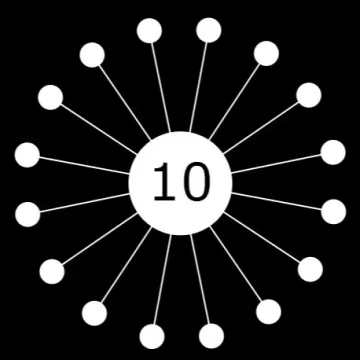
How to play Coreball?
Desktop / Laptop:
- Launch the ball- Left-click or press Space.
- Restart instantly - Press R.
Mobile / Tablet:
- Launch the ball - Tap anywhere on the screen.
- Restart instantly - Double-tap the screen.
What Is the Ultimate Goal of Coreball?
The ultimate goal of Coreball is to successfully attach every required pin to the rotating core without causing a collision. Each level gives you a specific number of pins to launch, and you must place them safely until the level is complete.
How Do You Win?
Winning a level depends on accuracy rather than speed alone. You need to launch all available pins into safe positions around the rotating core.
The most reliable process is:
- Observe the current rotation.
- Identify an open section.
- Wait for the opening to reach a suitable position.
- Launch one pin.
- Check how the new pin changes the remaining space.
- Repeat until every required pin has been placed.
The later stages become more difficult because the growing number of pins leaves fewer safe areas. Rotation speed can also become more demanding, requiring you to make decisions more quickly. Some versions and builds introduce additional movement or difficulty variations, increasing the importance of adaptation.
Winning is therefore not simply about pressing the button repeatedly. It is about understanding the relationship between the rotating core, the existing pins, and the timing of your next launch.
What Happens When You Lose?
You lose the current attempt when the pin you launch collides with a pin that is already attached to the core. A collision means the level is failed and you need to restart it.
This failure condition makes every launch important. A gap that looks large enough may become dangerous when the core rotates, especially when several pins are already positioned around the circle.
Fortunately, restarting is quick. On desktop, pressing R provides an instant restart, while the mobile version supports a quick restart gesture.
Instead of treating a failed attempt as wasted time, use it as information. Remember where the collision occurred, identify whether your launch was too early or too late, and adjust the next attempt.
What Difficulties Can You Face in Coreball?
The main challenge in Coreball is the growing demand for precise timing. The basic mechanic remains familiar throughout the game, but the conditions surrounding each launch can become increasingly difficult.
Finding the Right Opening
One of the first challenges is recognizing which gaps are actually safe. A space may look open when you first see it, but the rotating core can move it away from your ideal launch position within a fraction of a second.
To overcome this problem, avoid focusing on only one pin. Keep your attention on the entire circular structure. A wider view makes it easier to recognize where several pins are positioned and where the next safe opening is forming.
The safest gap is not always the largest gap. What matters is whether that gap will remain clear when your new pin reaches the core.
Dealing With Faster Rotation
As the difficulty increases, the rotating core can demand faster reactions and more accurate prediction. Some versions describe major difficulty changes as progression advances, with tighter timing windows and more complicated patterns.
When the rotation becomes faster, avoid panicking. Rapid clicking usually makes your timing less accurate. Instead, watch one complete movement cycle and learn the new rhythm.
Try to anticipate the gap rather than waiting for it to appear directly in front of you. This small change in thinking can make fast stages much more manageable.
Managing Limited Space
Every successful launch changes the level. Once a pin has been attached, that area is no longer available for another pin. As more pins accumulate around the core, your choices become narrower.
This means a good player must think beyond the current shot. Consider where the next one or two pins might need to go before using the easiest opening.
A practical strategy is to use larger spaces when they appear, especially when you are still learning the rotation pattern. Save yourself from unnecessary risk by avoiding extremely narrow gaps unless the level requires them.
Avoiding Impulsive Clicks
One of the biggest mistakes beginners make is clicking because they feel they have waited too long. Coreball rewards patience, so there is no advantage in launching a pin simply because an opening looks close.
Give the core another rotation when necessary. A missed opportunity is usually less costly than a collision.
This mindset is particularly useful on harder levels. Staying calm allows you to observe the pattern, while impulsive clicks often turn a manageable situation into an immediate failure.
Recovering From a Mistake
Not every failed attempt means you need a completely new strategy. Sometimes your timing was only slightly off.
After a collision, ask yourself three simple questions:
- Did I launch too early?
- Did I launch too late?
- Did I underestimate the space between existing pins?
Your answer can guide the next attempt. Because Coreball allows quick restarts, repeating a level several times can help develop muscle memory and improve your understanding of its rhythm.
Players who enjoy this type of simple-but-demanding gameplay may also like Daddy Long Legs, another casual skill game that turns straightforward controls into a surprisingly difficult challenge. It offers a different movement system while keeping the same pick-up-and-play appeal.