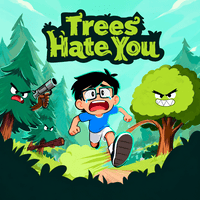
Discover Trees Hate You. A dark comedy platformer filled with unexpected traps where every step can cause players to fail if they lose focus.
Overview of Trees Hate You
Trees Hate You is a game in the rage comedy genre, combining dark humor with frustrating challenges. In the game, players do not simply overcome obstacles but must "survive" in a forest designed to deliberately work against them. Your journey is not just about traveling through the forest but also facing a series of trap filled challenges that directly target the player's sense of carelessness.
" system. Trees can fall down, paths can collapse, and areas that appear safe may actually be the most dangerous places. Every movement carries the possibility of failure, but this is exactly what creates the game's unique appeal.
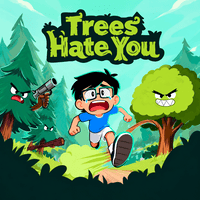
Trees Hate You is a rage-comedy indie game
3 Things You Need to Know Before Playing Trees Hate You
This is not a game for "speed running"
New players often make the mistake of constantly trying to move forward quickly. However, high speed in Trees Hate You is almost equal to failure. The game prioritizes observation and careful thinking over reflexes.
Death is part of the gameplay
Unlike many other games, failure in Trees Hate You happens constantly and is intentionally designed that way. Every death teaches players how to recognize traps and remember the structure of each level.
There is no "absolute safety"
One of the game's most impressive features is that it does not provide clearly safe areas. Even places that seem completely stable can suddenly become unexpected traps.
Detailed Guide on How to Play Trees Hate You
- Use the A/D keys or the left and right arrow keys to move the character.
- Press the Space key or W to jump.
- Press the R key to restart the level or reset your current position.
- After unlocking the Dash ability later in the game, players can press the Shift key to activate it.
How to Recognize Traps in Trees Hate You
To play better, players need to learn how to "read the environment" because most traps in the game are not clearly indicated in advance.
Common signs of traps:
- Paths that look too perfect: If a path seems too easy or too convenient, it is most likely a trap.
- Objects placed unnaturally: Trees, signs, or pieces of ground positioned strangely often hide trigger mechanisms.
- Intentionally repetitive design: The game frequently uses repeating patterns to trick players into believing an area is safe.
- "Suspiciously empty" spaces: Empty areas without obstacles can sometimes be where unexpected events occur.
In a world where everything in the game can "betray" the player, the most important skill is not reflexes but the ability to observe and stay calm. Try this game yourself and experience its interesting situations in 101games.